Why having more data is making it harder (not easier) to make decisions
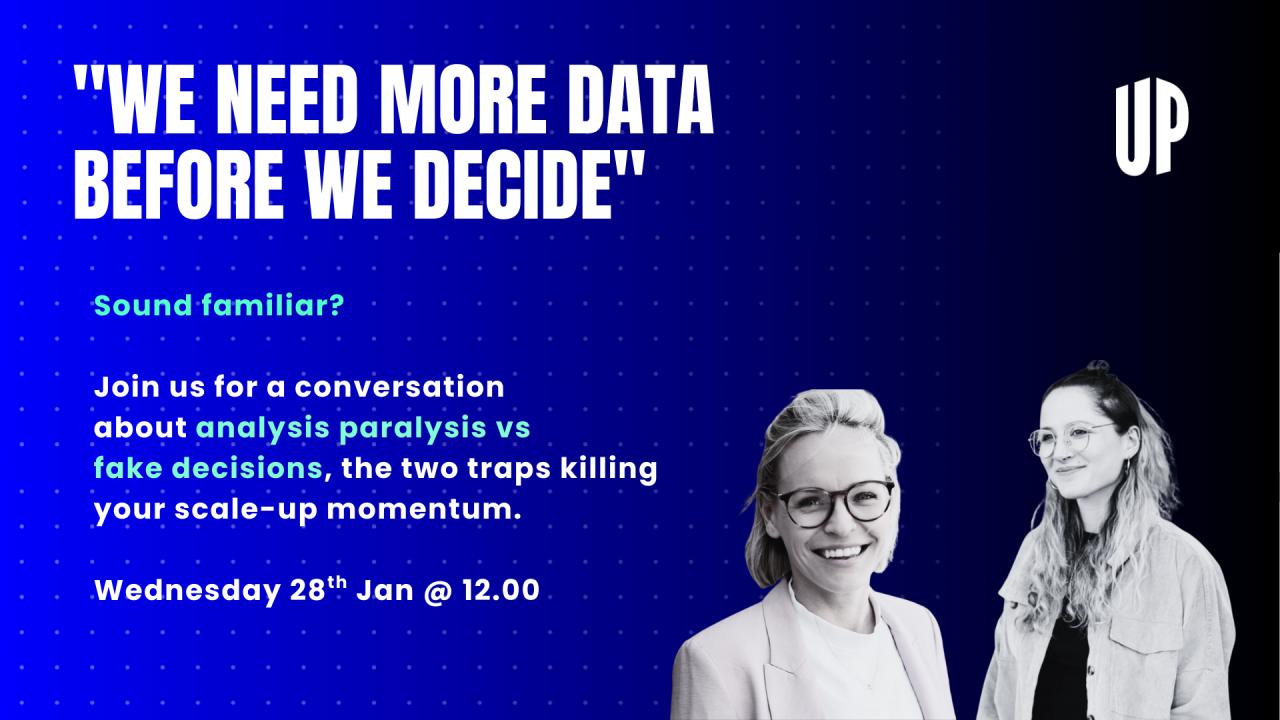
Quick question: are you currently stuck between "we need more customer interviews before we decide" and "let's test 5 channels to see what works"?
If so, you're not alone. And you're probably not stuck because you lack information.
You're stuck because you're treating two different avoidance behaviours as strategic decision-making.
The two traps killing your momentum
I see this pattern constantly with the scale-ups we work with:
Trap 1: Analysis paralysis - Saying "we need more data before we decide on our ICP" when you already have enough signal to move forward
Trap 2: Fake decisions - Saying "we're testing 5 channels" but spreading your budget so thin (£500 per channel, anyone?) that you'll learn absolutely nothing
Both feel productive. Both feel strategic. Both kill momentum.
Meanwhile, your runway burns, competitors move, and 6 months later you're still stuck in the same place.
The AI data overwhelm problem
Here's what's making this worse: AI is creating an overwhelming amount of data that's actually delaying decision-making rather than enhancing it.
You can now analyse everything. Survey everyone. Test infinite variations. ChatGPT will happily generate 47 different strategic options for you.
But here's the thing: AI is an input, not a decision maker
Having more data doesn't make the decision easier - it often makes it harder. You end up drowning in possibilities, waiting for one more data point that will give you certainty that simply isn't coming.
What we discussed yesterday
Our Head of Insights Anna Sandford-James and our Portfolio CMO Ness Rustom tackled this head-on in yesterday's live session, and honestly, it was brilliant.
I've worked with both of them for the last four years, and they are two of the smartest people I've ever worked with. I'm so proud they're part of The Scale Up Collective.
What makes them brilliant isn't just their expertise - it's that they've both lived this problem from different angles. Anna has spent years helping companies make sense of data and turn it into direction. Ness has been on the sharp end of having to make high-stakes decisions with imperfect information.
What they covered
→ Why both traps feel like "being careful" but are actually avoidance
→ What real decisions look like (and why they require actual risk)
→ How to use directional confidence instead of waiting for statistical significance
→ The actual role of research (spoiler: it's not to guarantee outcomes)
→ A 4-step framework you can use THIS WEEK on a real decision
This wasn't theory. It was drawn from the work we do with scaling businesses every week.
Here's what real decisions require:
- Actual commitment - resources, focus, clear trade-offs
- Directional confidence, not statistical significance (you're unlikely to reach 95% confidence with your limited budget anyway)
- Clear signals for when to pivot - not proof it'll work, but thresholds for "enough to continue"
The latin root of "decision" comes from decidere - meaning "to cut off". Making a decision means cutting off other possibilities to commit to one choice.
If you can't name what you're saying no to, you haven't actually decided.
Watch the replay if:
- You're feeling the pressure to "have it figured out" before you move
- You've got multiple strategic options and can't commit to one
- You're waiting for one more piece of data before making a call
- You're "testing" multiple things but learning nothing definite
Watch the full conversation here
If you're stuck between over-analysing and under-committing, this conversation will help you break free.
.png)

.png)